

View on GitHub
Open this notebook in GitHub to run it yourself
Hybrid Classical-Quantum Neural Network
Classical Neural Networks
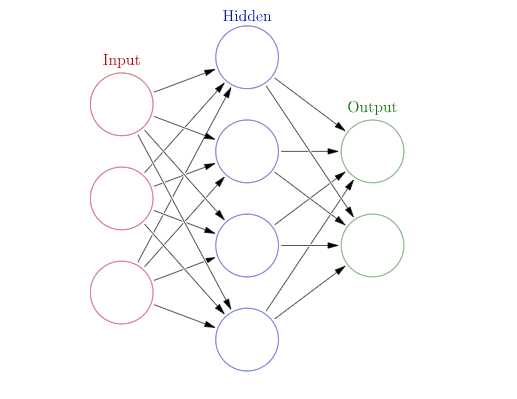
Neural networks is one of the major branches in machine learning, with wide use in applications and research. A neural network—or, more generally, a deep neural network—is a parametric function of a specific structure (inspired by neural networks in biology), which is trained to capture specific functionality. In its most basic form, a neural network for learning a function looks as follows:- There is an input vector of size (red circles in Fig. 1).
- Each entry of the input goes into a hidden layer of size , where each neuron (blue circles in Fig. 1) is defined with an “activation function” for , and are parameters.
- The output of the hidden layer is sent to the output layer (green circles in Fig. 1) for , and are parameters.
Quantum Neural Networks
The idea of a quantum neural network refers to combining parametric circuits as a replacement for all or some of the classical layers in classical neural networks. The basic object in QNN is thus a quantum layer, which has a classical input and returns a classical output. The output is obtained by running a quantum program. A quantum layer is thus composed of three parts:- A quantum part that encodes the input: This is a parametric quantum function for representing the entries of a single data point.
- A quantum ansatz part: This is a parametric quantum function, whose parameters are trained as the weights in classical layers.
- A postprocess classical part, for returning an output classical vector.
Example: Hybrid Neural Network for the Subset Majority Function
For an integer and a given subset of indices we define the subset majority function, that acts on binary strings of size as follows: it returns 1 if the number of ones within the substring according to is larger than , and 0 otherwise, For example, we consider and :- The string 0101110 corresponds to the substring 011, for which the number of ones is 2(>1). Therefore, .
- The string 0011111 corresponds to the substring 001, for which the number of ones is 1(=1). Therefore, .
Generating Data for a Specific Example
Let us consider a specific example for our demonstration. We choose and generate all possible data of bit strings. We also take a specific subset .Constructing a Hybrid Network
We build the following hybrid neural network: Data flattening A classical linear layer of size 10 to 4 withTanh activation A qlayer of size 4 to 2 a classical linear layer of size 2 to 1 with ReLU activation.
The classical layers can be defined with PyTorch built-in functions.
The quantum layer is constructed with
(1) a dense angle-encoding function
(2) a simple ansatz with RY and RZZ rotations
(3) a postprocess that is based on a measurement per qubit
The Quantum Layer
Output:
The Full Hybrid Network
Now, we can define the full network.Training and Verifying the Networks
We define some hyperparameters such as loss function and optimization method, and a training function:train function:
check_accuracy, which tests a trained network on new data:
Training and Verifying the Network
For convenience, we load a pre-trained model and set the epoch size to- Training a network takes around 30 epochs.
Output:
Output: