View on GitHub

Open this notebook in GitHub to run it yourself

Decoded Quantum Interferometry Algorithm

This notebook relates to the paper “Optimization by Decoded Quantum Interferometry” (DQI) [1], which introduces a quantum algorithm for combinatorial optimization problems. The algorithm focuses on finding approximate solutions to the max-LINSAT problem, and takes advantage of the sparse Fourier spectrum of certain optimization functions.

max-LINSAT Problem

  • Input: A matrix BFm×nB \in \mathbb{F}^{m \times n} and mm functions fi:F{+1,1}f_i : \mathbb{F} \rightarrow \{+1, -1\} for i=1,,mi = 1, \cdots, m , where F\mathbb{F} is a finite field.
Define the objective function f:FnZf : \mathbb{F}^n \rightarrow \mathbb{Z} to be f(x)=i=1mfi(j=1nBijxj)f(x) = \sum_{i=1}^m f_i \left( \sum_{j=1}^n B_{ij} x_j \right).
  • Output: a vector xFnx \in \mathbb{F}^n that best maximizes ff.
The paper shows that for the problem of Optimal Polynomial Intersection (OPI)—a special case of the the max-LINSAT—the algorithm can reach a better approximation ratio than any known polynomial time classical algorithm. We demonstrate the algorithm in the setting of max-XORSAT, which is another special case of max-LINSAT, and is different from the OPI problem. Even though the paper does not show a quantum advantage with max-XORSAT, it is simpler to demonstrate.

max-XORSAT Problem

  • Input: A matrix BF2m×nB \in \mathbb{F}_2^{m \times n} and a vector vF2mv \in \mathbb{F}_2^m with m>nm > n.
Define the objective function f:F2nZf : \mathbb{F}_2^n \rightarrow \mathbb{Z} as f(x)=i=1m(1)vi+bix=i=1mfi(x)f(x) = \sum_{i=1}^m (-1)^{v_i + b_i \cdot x} = \sum_{i=1}^m f_i(x) (with bib_i the columns of BB), which represents the number of satisfied constraints minus the number of unsatisfied constraints for the equation Bx=vBx=v.
  • Output: a vector xF2nx \in \mathbb{F}_2^n that best maximizes ff.
The max-XORSAT problem is NP-hard. As an example, the Max-Cut problem is a special case of max-XORSAT where the number of ones in each row is exactly two. The DQI algorithm focuses on finding approximate solutions to the problem.

Algorithm Description

The strategy is to prepare this state: P(f)=xF2nP(f(x))x|P(f)\rangle = \sum_{x\in\mathbb{F}_2^n}P(f(x))|x\rangle where PP is a normalized polynomial. Choosing a good polynomial can bias the sampling of the state towards high ff values. The higher the degree ll of the polynomial, the better approximation ratio of the optimum we can get. The Hadamard spectrum of P(f)|P(f)\rangle is k=0lwk(mk)yF2my=k(1)vyBTy\sum_{k = 0}^{l} \frac{w_k}{\sqrt{\binom{m}{k}}} \sum_{\substack{y \in \mathbb{F}_2^m \\ |y| = k}} (-1)^{v \cdot y} |B^T y\rangle where wkw_k are normalized weights that can be calculated from the coefficients of PP. So, to prepare P(f)|P(f)\rangle, we prepare its Hadamard transform, then apply the Hadamard transform over it. Stages:
  1. Prepare k=0lwkk\sum_{k=0}^l w_k|k\rangle.
  2. Translate the binary encoded k|k\rangle to a unary encoded state kunary=11k00nk|k\rangle_{unary} = |\underbrace{1 \cdots 1}_{k} \underbrace{0 \cdots 0}_{n - k} \rangle, resulting in the state k=0lwkkunary\sum_{k=0}^l w_k|k\rangle_{unary}.
  3. Translate each kunary|k\rangle_{unary} to a Dicke state [2], resulting in the state {k=0}{l}{wk}{{({m)}{k}}}{{y{F}2my=k}}ym\sum_\{k = 0\}^\{l\} \frac\{w_k\}\{\sqrt\{\binom\{m\}\{k\}\}\} \sum_\{\substack\{y \in \mathbb\{F\}_2^m \\ |y| = k\}\} |y\rangle_m.
  4. For each ym|y\rangle_m, calculate (1)vyymBTyn(-1)^{v \cdot y} |y\rangle_m |B^T y\rangle_n, getting {k=0}{l}{wk}{{({m)}{k}}}{{y{F}2my=k}}(1){vy}ymBTyn\sum_\{k = 0\}^\{l\} \frac\{w_k\}\{\sqrt\{\binom\{m\}\{k\}\}\} \sum_\{\substack\{y \in \mathbb\{F\}_2^m \\ |y| = k\}\} (-1)^\{v \cdot y\} |y\rangle_m |B^T y\rangle_n.
  5. Uncompute ym|y\rangle_m by decoding BTyn|B^T y\rangle_n.
  6. Apply the Hadamard transform to get the desired P(f)|P(f)\rangle.
Step 5 is the heart of the algorithm. The decoding of BTyn|B^T y\rangle_n is, in general, an ill-defined problem, but when the hamming weight of yy is known to be limited by some integer l (the degree of PP) , it might be feasible and even efficient, depending on the structure of the matrix BB. The problem is equivalent to the decoding error from syndrome [3], where BTB^T is the parity-check matrix. Figure 1 shows a layout of the resulting quantum program. Executing the quantum program guarantees that we sample x with high ff values with high probability (see the last plot in this notebook). image.png *Figure

  1. The full DQI circuit for a MaxCut problem.
The x solutions are sampled from the target variable after the last Hadamard transform.*

Defining the Algorithm Building Blocks

Next, we define the needed building-blocks for all algorithm stages. Step 1 is omitted as we use the built-in prepare_amplitudes function.

Step 2: Encoding Conversions

We use three different encodings:
  • Binary encoding: Represents a number using binary bits, where each qubit corresponds to a binary place value.
For example, the number 3 on 4 qubits is 1100|1100\rangle.
  • One-hot encoding: Represents a number by activating a single qubit, with its position indicating the value.
For example, the number 3 on 4 qubits is 0001|0001\rangle.
  • Unary encoding: Represents a number by setting the first kk qubits to 1 kk is the number, and the rest to
  1. For example, the number 3 on 4 qubits is 1110|1110\rangle.
Specifically, we translate a binary (unsigned QNum) to one-hot encoding, and show how to convert the one-hot encoding to a unary encoding. The conversions are done in place, meaning that the same binary encoded quantum variable is extended to represent the target encoding. We use the library function binary_to_unary, based on this post. Let’s test the conversion of the number 8 from binary to unary:
import numpy as np

from classiq import *


@qfunc
def main(one_hot: Output[QArray]):
    binary = QNum()
    binary |= 8
    binary_to_unary(binary, one_hot)


qprog_one_hot = synthesize(main)
res_one_hot = execute(qprog_one_hot).get_sample_result()
res_one_hot.dataframe
one_hotcountprobabilitybitstring
0[1, 1, 1, 1, 1, 1, 1, 1, 0, 0, 0, 0, 0, 0, 0]20481.0000000011111111

Step 3: Dicke State Preparation

We transform a unary input quantum variable to a Dicke state, such that U11k00nk=k=0l1(nk)y=kynU|\underbrace{1 \cdots 1}_{k} \underbrace{0 \cdots 0}_{n - k} \rangle = \sum_{k = 0}^{l} \frac{1}{\sqrt{\binom{n}{k}}} \sum_{\substack{|y| = k}} |y\rangle_n We use the library function prepare_dicke_state, with a recursive implementation that is based on [2]. The recursion works bit by bit. We test the function for the Dicke state of 6 qubits with 4 ones:
@qfunc
def main(qvar: Output[QArray]):
    allocate(6, qvar)
    prepare_dicke_state(4, qvar)


qprog_dicke = synthesize(main)
res_dicke = execute(qprog_dicke).get_sample_result()
res_dicke.dataframe.head(7)
qvarcountprobabilitybitstring
0[1, 1, 0, 0, 1, 1]1610.078613110011
1[1, 1, 0, 1, 1, 0]1550.075684011011
2[1, 0, 1, 1, 1, 0]1530.074707011101
3[0, 1, 1, 1, 1, 0]1440.070312011110
4[0, 0, 1, 1, 1, 1]1420.069336111100
5[0, 1, 1, 0, 1, 1]1390.067871110110
6[1, 0, 1, 0, 1, 1]1380.067383110101
In the DQI setting, we will want to prepare a Dicke state given a unary encoded quantum variable. We will use the function prepare_dicke_state_unary_input, which is actually a subrutine of prepare_dicke_state:
@qfunc
def main(qvar: Output[QArray]):
    allocate(6, qvar)
    # prepare 2 encoded in unary: |110000>
    qvar[0] ^= 1
    qvar[1] ^= 1
    prepare_dicke_state_unary_input(qvar.len, qvar)


qprog_dicke_unary_input = synthesize(main)
res_dicke_unary_input = execute(qprog_dicke_unary_input).get_sample_result()
res_dicke_unary_input.dataframe.head(7)
qvarcountprobabilitybitstring
0[1, 0, 0, 1, 0, 0]1560.076172001001
1[0, 0, 1, 0, 1, 0]1530.074707010100
2[1, 0, 0, 0, 0, 1]1470.071777100001
3[0, 0, 0, 0, 1, 1]1470.071777110000
4[1, 1, 0, 0, 0, 0]1430.069824000011
5[0, 0, 1, 1, 0, 0]1420.069336001100
6[0, 0, 0, 1, 0, 1]1420.069336101000

Step 4: Vector and Matrix Products

Define a matrix and vector product over the binary field functions:
from functools import reduce

from classiq.qmod.symbolic import pi


@qfunc
def vector_product_phase(v: CArray[CInt], y: QArray):
    phase(pi * sum(v[i] * y[i] for i in range(v.len)))


@qfunc
def matrix_vector_product(B: list[list[int]], y: QArray, out: Output[QArray]):
    allocate(len(B), out)
    for i in range(len(B)):
        out[i] ^= reduce(
            lambda x, y: x ^ y, [int(B[i][j]) * y[j] for j in range(y.len)]
        )

Assembling the Full max-XORSAT Algorithm

Here, we combine all the building blocks into the full algorithm. To save qubits, the decoding is done in place, directly onto the y|y\rangle register. The only remaining part is the decoding, that will be treated after choosing the problem to optimize, as it depends on the input structure. dqi_max_xor_sat is the main quantum function of the algorithm. It expects the following arguments:
  • B: the (classical) constraints matrix of the optimization problem
  • v: the (classical) constraints vector of the optimization problem
  • w_k: a (classical) vector of coefficients wkw_k corresponding to the polynomial transformation of the target function.
The index of the last non-zero element sets the maximum number of errors that the decoder should decode
  • y: the (quantum) array of the errors for the decoder to decode. If the decoder is perfect, it should hold only zeros at the output
  • solution: the (quantum) output array of the solution. It holds BTy|B^Ty\rangle before the Hadamard transform.
  • syndrome_decode: a quantum callable that accepts a syndrome quantum array and outputs the decoded error on its second quantum argument
@qfunc
def dqi_max_xor_sat(
    B: list[list[int]],
    v: list[int],
    w_k: list[float],
    y: Output[QArray],
    solution: Output[QArray],
    syndrom_decode: QCallable[QArray, QArray],
):
    k_num_errors = QNum()
    prepare_amplitudes(w_k, 0, k_num_errors)

    k_unary = QArray()
    binary_to_unary(k_num_errors, k_unary)

    # pad with 0's to the size of m
    pad_zeros(B.len, k_unary, y)

    # Create the Dicke states
    max_errors = int(np.nonzero(w_k)[0][-1]) if np.any(w_k) else 0
    prepare_dicke_state_unary_input(max_errors, y)

    # Apply the phase
    vector_product_phase(v, y)

    # Compute |B^T*y> to a new register
    matrix_vector_product(np.array(B).T.tolist(), y, solution)

    # uncompute |y>
    # decode the syndrom inplace directly on y
    syndrom_decode(solution, y)

    # transform from Hadamard space to function space
    hadamard_transform(solution)

Example Problem: Max-Cut for Regular Graphs

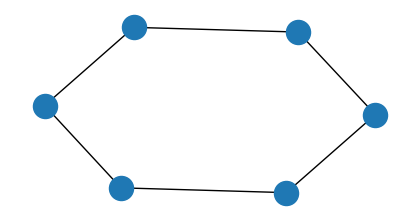
Now, let’s be more specific and optimize a Max-Cut problem. We choose specific parameters so that with the resulting BB matrix we can decode up to two errors on the vector y|y\rangle. The translation between Max-Cut and max-XORSAT is quite straightforward. Every edge is a row, with the nodes as columns. The vv vector is all ones, so that if (vi,vj)E(v_i, v_j) \in E, we get a constraint xixj=1x_i \oplus x_j = 1, which is satisfied if xix_i, xjx_j are on different sides of the cut.
import itertools
import warnings

import matplotlib.pyplot as plt
import networkx as nx

warnings.filterwarnings("ignore", category=FutureWarning)


# A 2-regular graph on 6 nodes
G = nx.Graph()
G.add_nodes_from([3, 4, 1, 5, 2, 0])
G.add_edges_from([(3, 4), (3, 2), (4, 1), (1, 5), (5, 0), (2, 0)])

B = nx.incidence_matrix(G).T.toarray()
v = np.ones(B.shape[0])

plt.figure(figsize=(4, 2))
nx.draw(G)
print("B matrix:\n", B)
Output:

B matrix:
   [[

1. 1. 

0. 0. 

0. 0.]
   [

1. 0. 

0. 0. 

1. 0.]
   [

0. 1. 

1. 0. 

0. 0.]
   [

0. 0. 

1. 1. 

0. 0.]
   [

0. 0. 

0. 1. 

0. 1.]
   [

0. 0. 

0. 0. 

1. 1.]]
  

output

Original Sampling Statistics

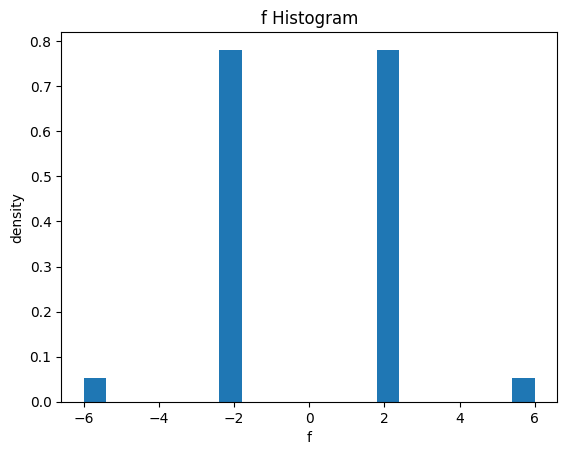
Let’s plot the statistics of ff for uniformly sampling xx, as a histogram. Later, we show how to get a better histogram after sampling from the state of the DQI algorithm.
# plot f statistics
all_inputs = np.array(list(itertools.product([0, 1], repeat=B.shape[1]))).T
f = ((-1) ** (B @ all_inputs + v[:, np.newaxis])).sum(axis=0)

# plot a histogram of f
plt.hist(f, bins=20, density=True)
plt.xlabel("f")
plt.ylabel("density")
plt.title("f Histogram")
plt.show()
output

Decodability of the Resulting Matrix

The transposed matrix of the specific matrix we have chosen can be decoded with up to two errors, which corresponds to a polynomial transformation of ff of degree 2 in the amplitude, and degree 4 in the sampling probability:
# set the code length and possible number of errors
MAX_ERRORS = 2  # l in the paper
n = B.shape[0]

# Generate all vectors in one line
errors = np.array(
    [
        np.array([1 if i in ones_positions else 0 for i in range(n)])
        for num_ones in range(MAX_ERRORS + 1)
        for ones_positions in itertools.combinations(range(n), num_ones)
    ]
)
syndromes = (B.T @ errors.T % 2).T

print("num errors:", errors.shape[0])
print("num syndromes:", len(set(tuple(x) for x in list((syndromes)))))
print("B shape:", B.shape)
Output:
num errors: 22
  num syndromes: 22
  B shape: (6, 6)
  

Step 5: Defining the Decoder

For this basic demonstration, we use a brute force decoder that uses a lookup table for decoding each syndrome in superposition:
def _to_int(binary_array):
    return int("".join(str(int(bit)) for bit in reversed(binary_array)), 2)


@qfunc
def syndrome_decode_lookuptable(syndrome: QNum, error: QNum):
    for i in range(len(syndromes)):
        control(
            syndrome == _to_int(syndromes[i]),
            lambda: inplace_xor(_to_int(errors[i]), error),
        )
It is also possible to define a decoder that uses a local rule of syndrome majority. This decoder can correct just one error.
@qfunc
def syndrome_decode_majority(syndrome: QArray, error: QArray):
    for i in range(B.shape[0]):
        # if 2 syndromes are 1, then the decoded bit will be 1, else 0
        synd_1 = np.nonzero(B[i])[0][0]
        synd_2 = np.nonzero(B[i])[0][1]
        error[i] ^= syndrome[synd_1] & syndrome[synd_2]

Choosing Optimal wkw_k Coefficients

According to the paper [1], this is done by finding the principal value of a tridiagonal matrix AA defined by the following code. The optimality is with regard to the expected ratio of satisfied constraints.
def get_optimal_w(m, n, l):
    # max-xor sat:
    p = 2
    r = 1
    d = (p - 2 * r) / np.sqrt(r * (p - r))

    # Build A matrix
    diag = np.arange(l + 1) * d
    off_diag = [np.sqrt(i * (m - i + 1)) for i in range(1, l + 1)]
    A = np.diag(diag) + np.diag(off_diag, 1) + np.diag(off_diag, -1)

    # get W_k as the principal vector of A
    eigenvalues, eigenvectors = np.linalg.eig(A)
    principal_vector = eigenvectors[:, np.argmax(eigenvalues)]

    # normalize
    return principal_vector / np.linalg.norm(principal_vector)


# normalize
W_k = get_optimal_w(m=B.shape[0], n=B.shape[1], l=MAX_ERRORS)

print("Optimal w_k vector:", W_k)
# complete W_k to a power of 2 for the usage in prepare_state
W_k = np.pad(W_k, (0, 2 ** int(np.ceil(np.log2(len(W_k)))) - len(W_k)))
Output:

Optimal w_k vector: [0.4330127  0.70710678 0.55901699]
  

Synthesis and Execution of the Full Algorithm

from classiq.execution import *


@qfunc
def main(y: Output[QArray], solution: Output[QArray]):
    dqi_max_xor_sat(
        B.tolist(),
        v.tolist(),
        W_k.tolist(),
        y,
        solution,
        syndrome_decode_lookuptable,
    )


qmod = create_model(
    main,
    constraints=Constraints(optimization_parameter="width"),
    execution_preferences=ExecutionPreferences(num_shots=10000),
)

qprog = synthesize(qmod)
show(qprog)
Output:

Quantum program link: https://platform.classiq.io/circuit/36FEtf36OBpFvMac5yCd1aSkh8j
  

res = execute(qprog).get_sample_result()
res.dataframe
y solution count probability bitstring
0 [0, 0, 0, 0, 0, 0] [0, 1, 0, 1, 1, 0] 2966 0.2966 011010000000
1 [0, 0, 0, 0, 0, 0] [1, 0, 1, 0, 0, 1] 2893 0.2893 100101000000
2 [0, 0, 0, 0, 0, 0] [0, 1, 1, 0, 1, 0] 138 0.0138 010110000000
3 [0, 0, 0, 0, 0, 0] [0, 1, 0, 0, 1, 0] 136 0.0136 010010000000
4 [0, 0, 0, 0, 0, 0] [1, 0, 0, 1, 0, 1] 136 0.0136 101001000000
59 [0, 0, 0, 0, 0, 0] [1, 0, 0, 0, 1, 0] 8 0.0008 010001000000
60 [0, 0, 0, 0, 0, 0] [1, 0, 0, 0, 1, 1] 8 0.0008 110001000000
61 [0, 0, 0, 0, 0, 0] [0, 1, 1, 1, 1, 1] 8 0.0008 111110000000
62 [0, 0, 0, 0, 0, 0] [0, 0, 0, 1, 0, 1] 7 0.0007 101000000000
63 [0, 0, 0, 0, 0, 0] [1, 0, 0, 1, 1, 1] 7 0.0007 111001000000

64 rows × 5 columns

We verify that the decoder uncomputed the y variable correctly:
assert sum(sum(sample.state["y"]) for sample in res.parsed_counts) == 0
And we can observe that the y vector is indeed clean.

Postprocessing

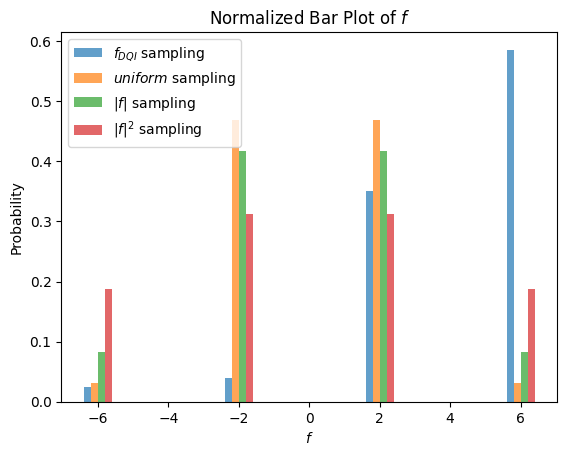
Finally, we plot the histogram of the sampled ff values from the algorithm, and compare it to a uniform sampling of xx values, and also to sampling weighted by f|f| and f2|f|^2 values. We can see that the DQI histogram is biased to higher ff values compared to the other sampling methods.
import matplotlib.pyplot as plt
import numpy as np

# Example data initialization
f_sampled = []
shots = []

# Populate f_sampled and shots based on res.parsed_counts
for sample in res.parsed_counts:
    solution = sample.state["solution"]
    f_sampled.append(((-1) ** (B @ solution + v)).sum())
    shots.append(sample.shots)
f_sampled = np.array(f_sampled)
shots = np.array(shots)

unique_f_sampled, indices = np.unique(f_sampled, return_inverse=True)
prob_f_sampled = np.array(
    [shots[indices == i].sum() for i in range(len(unique_f_sampled))]
)
prob_f_sampled = prob_f_sampled / prob_f_sampled.sum()

f_values, f_counts = np.unique(f, return_counts=True)
prob_f_uniform = np.array(f_counts) * np.array(f_values)
prob_f_uniform = f_counts / sum(f_counts)

prob_f_abs = np.array(f_counts) * np.array(np.abs(f_values))
prob_f_abs = prob_f_abs / prob_f_abs.sum()

prob_f_squared = np.array(f_counts) * np.array(f_values**2)
prob_f_squared = prob_f_squared / prob_f_squared.sum()


# Plot normalized bar plots
bar_width = 0.2
plt.bar(
    unique_f_sampled - 1.5 * bar_width,
    prob_f_sampled,
    width=bar_width,
    alpha=0.7,
    label="$f_{DQI}$ sampling",
)
plt.bar(
    f_values - 0.5 * bar_width,
    prob_f_uniform,
    width=bar_width,
    alpha=0.7,
    label="$uniform$ sampling",
)
plt.bar(
    f_values + 0.5 * bar_width,
    prob_f_abs,
    width=bar_width,
    alpha=0.7,
    label="$|f|$ sampling",
)
plt.bar(
    f_values + 1.5 * bar_width,
    prob_f_squared,
    width=bar_width,
    alpha=0.7,
    label="$|f|^2$ sampling",
)

plt.title("Normalized Bar Plot of $f$")
plt.xlabel("$f$")
plt.ylabel("Probability")
plt.legend()
plt.show()

print("<f_uniform>:", np.average(f))
print("<f_DQI>:", np.average(f_sampled, weights=shots))
output
Output:
<f_uniform>: 0.0
  <f_DQI>: 3.9904
  

References

[1]: Jordan, Stephen P., et al. “Optimization by Decoded Quantum Interferometry.” arXiv preprint arXiv:2408.08292 (2024). [2]: [Bärtschi, Andreas, and Stephan Eidenbenz. “Deterministic Preparation of Dicke States.” In Fundamentals of Computation Theory, pp. 126– 1
  1. Springer International Publishing, 2019.](http://dx.doi.org/10.1007/978-3-030-25027-0_9)
[3]: “Linear Block Codes: Encoding and Syndrome Decoding” from MIT’s OpenCourseWare.